
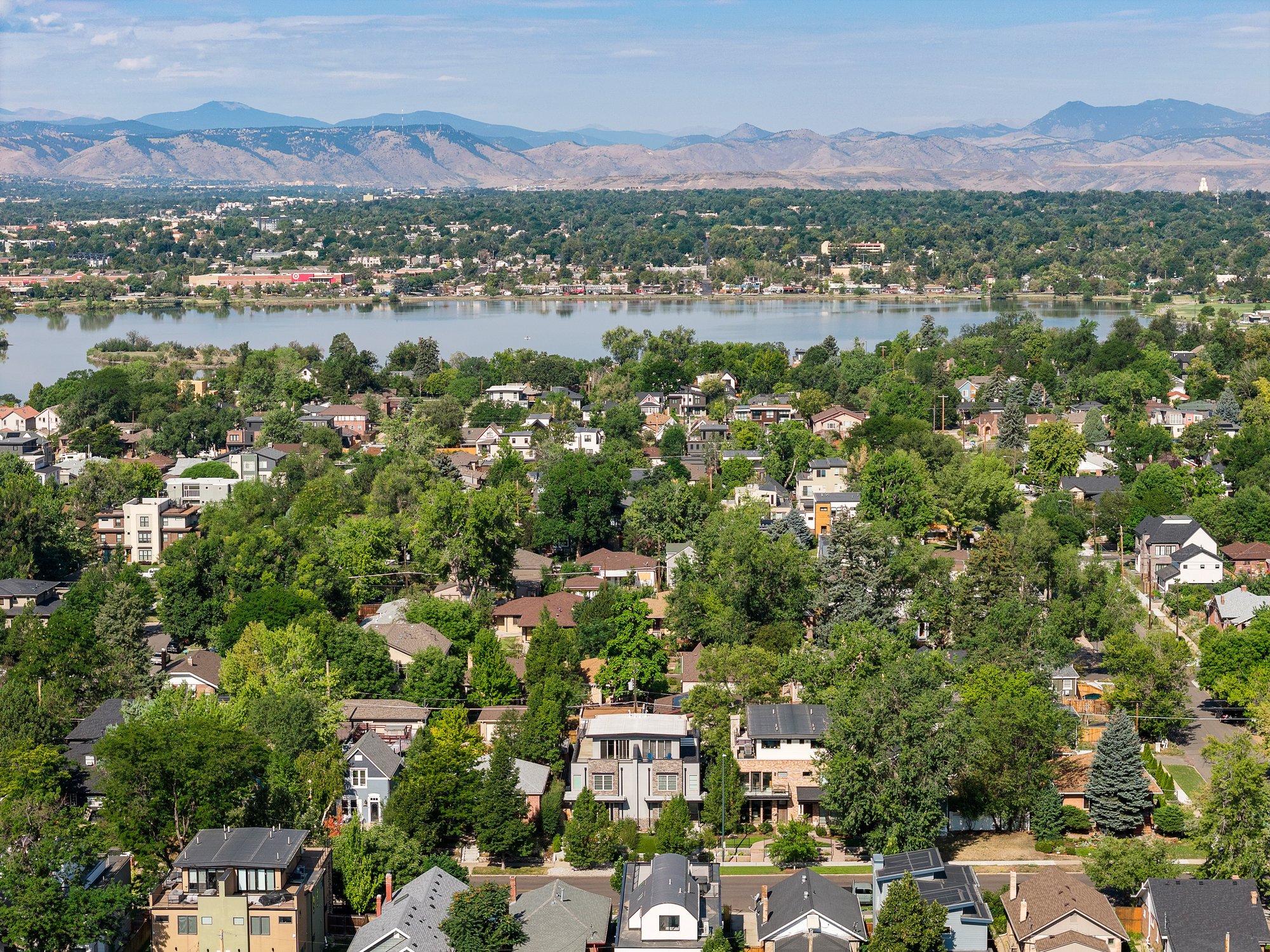
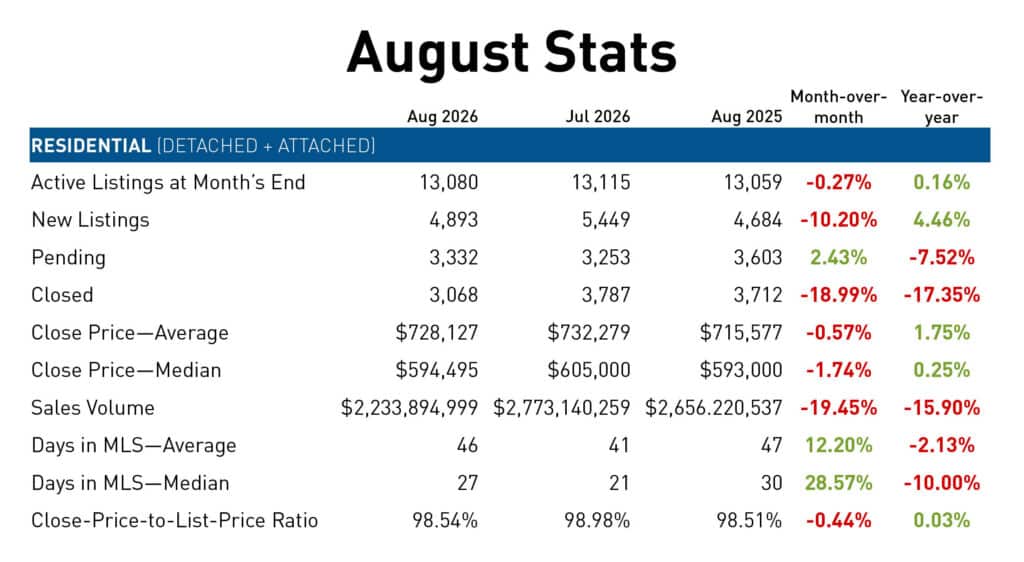
The Denver residential real estate market continued to show resilience in August 2026. Across all homes, single-family and condos and townhomes combined, the average sales price slipped 0.57% from July. It came in at $728,127. That’s still up 1.75% from a year ago, when it stood at $715,577. Here’s a breakdown of both segments.
Single-Family Homes: A Modest Dip and Steady Year-Over-Year Gains
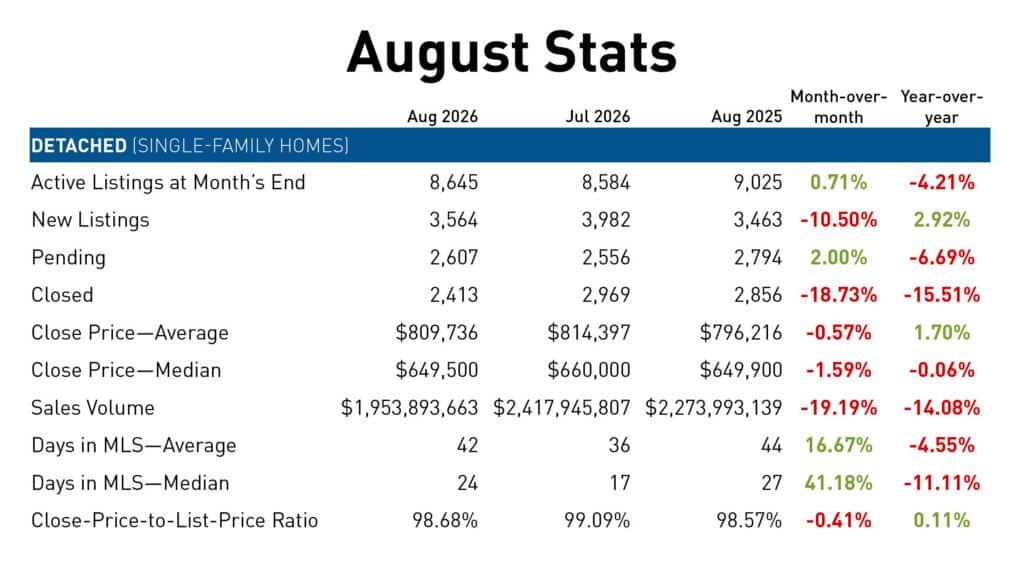
In the Denver residential real estate market, single-family homes, which have historically held their value better than condos and townhomes, saw only a modest 0.57% dip from July. The average sales price came in at $809,736, up 1.70% from $796,216 a year ago. The median price was $649,500, essentially unchanged from last August’s $649,900.
Here are the August numbers, compared with last month and last year.
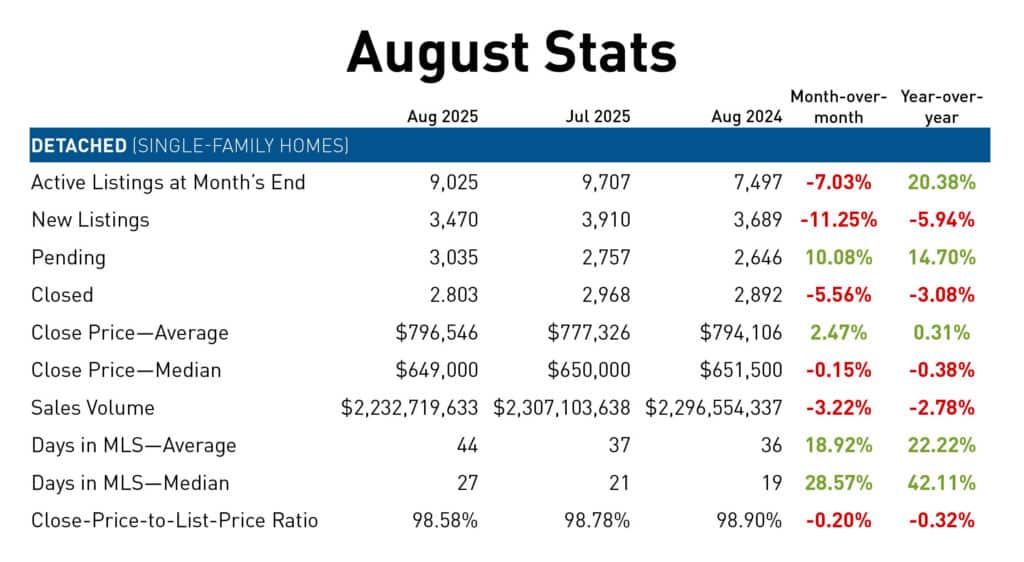
I’ve also included the same report from August 2025. As you can see, single-family homes continue to appreciate.
The average time on the MLS for single-family homes stayed in the 36 to 44 day range, reaffirming that this segment remains resilient to broader economic headwinds.
Why Single-Family Homes Hold Their Value in the Denver Residential Real Estate Market
That relative resilience comes down to the much broader pool of buyers single-family homes draw from. They’re the default choice for growing families, remote workers who need a dedicated office, multi-generational households and pet owners. Condos and townhomes, on the other hand, tend to attract a narrower group. That’s mostly first-time buyers, downsizers and investors.
The appeal goes beyond square footage. Single-family homes offer real privacy, with no shared walls, floors or ceilings. They also come with freedom from HOA restrictions on renovations, rentals and exterior changes. Buyers also get a yard for kids, pets or gardening. Mature trees and landscaping add curb appeal, and garages and driveways offer space for cars or storage. In addition, there’s often more room to expand or customize the home over time.
Access to top-rated school districts remains one of the biggest demand drivers, since many buyers will pay a premium for specific attendance boundaries. Finally, single-family homes come with land, which tends to appreciate on its own. That gives them a more durable value floor than attached homes, whose value is more exposed to building-specific issues like HOA finances, reserve funding, and rising insurance and dues.
Condos and Townhomes: Prices Slip as HOA Costs Climb
The average price for condos and townhomes came in at $427,483, down 1.55% from July’s $434,223 and down 4.26% from $446,527 a year ago. The median price was $370,000.
Within the Denver residential real estate market, condos and townhomes generally don’t appreciate at the same rate as single-family homes, and HOA dues are a major reason why. Over the past few years, dues have climbed sharply, driven by rising insurance premiums and utility costs. Affordability has always been the main draw for condo and townhome buyers, but as dues keep rising, that advantage is starting to erode.
Here are the August numbers for condos and townhomes, compared with last month and last year.
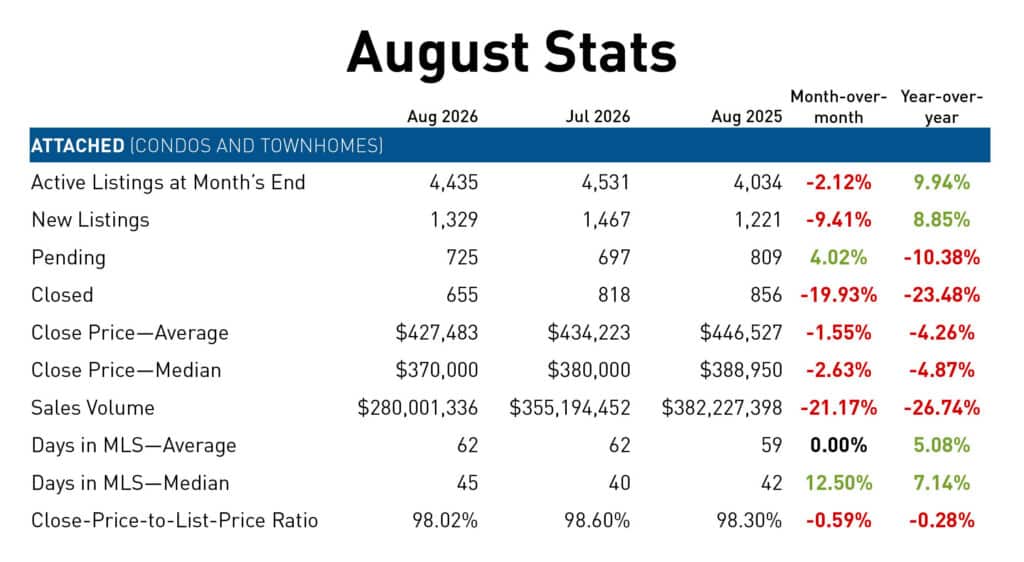
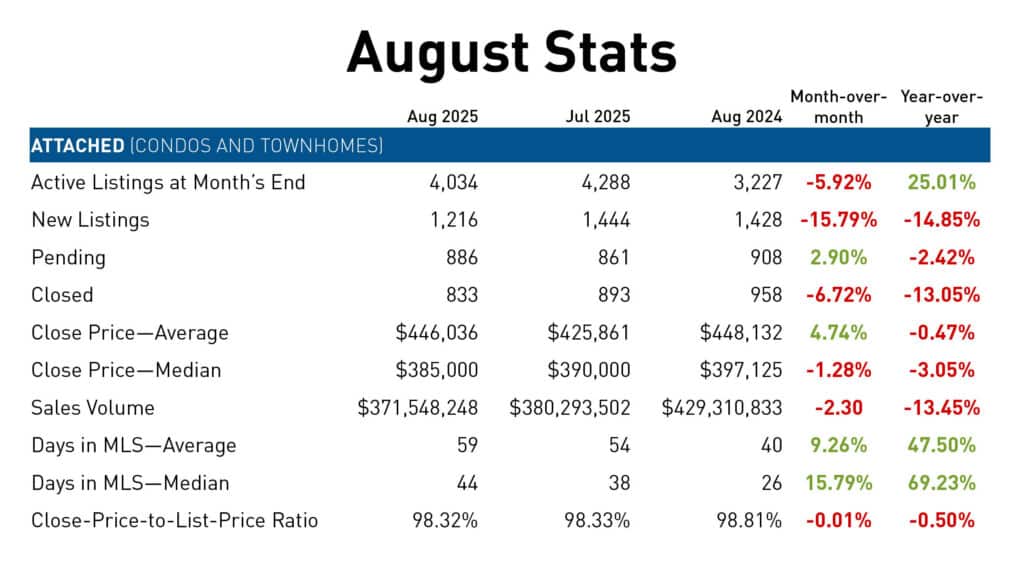
For comparison, here is the same report from August 2025. Condo and townhome prices have stayed flat. In fact, this August’s average price of $427,483 is nearly identical to July 2025’s $425,861.
New Condo Lending Rules: Why Due Diligence Matters More Than Ever
For anyone buying a condo in the Denver residential real estate market, due diligence is key. Many HOA boards aren’t run especially professionally, which is exactly why it matters. Before committing, buyers should learn as much as they can about the board members and review the meeting minutes, financials and reserve study. This is where working with a local agent who knows the buildings makes all the difference, and it’s a big part of how I help my condo buyers. If you’re looking at downtown condos, my LoDo guide covers what to compare building by building.
The lending landscape has raised the stakes for condo buyers across the Denver residential real estate market, too. As of March, Fannie Mae and Freddie Mac require lenders to review a condo association’s finances, reserve funding, building maintenance and any structural issues before approving a loan. CNBC covered the changes in an in-depth article on the new condo mortgage rules. You can also read Freddie Mac’s condo unit mortgage guidelines and Fannie Mae’s full review process.
What August Tells Us About the Denver Residential Real Estate Market
The market we’re in is the market we have, and August made that clear: measured, patient and driven more by life circumstances than by strategy.
Buyers are moving more slowly, and sellers are adjusting to longer timelines. Homes that closed in August spent a median of 27 days on the MLS, up from 21 in July, but still faster than last August’s 30-day median.
Meanwhile, the close-price-to-list-price ratio came in at 98.54%, slightly below July’s 98.98% and essentially flat from 98.51% a year ago. That’s a sign that patience on timing isn’t turning into deeper price cuts. Buyers seem to be waiting for the right home, not holding out for a discount.
Thinking about buying? Start with my step-by-step home buying guide. Planning to sell? Here’s how I market and list homes.
Source: Denver Metro Association of Realtors (DMAR) Market Trends Report, August 2026.
